Home › Legal Guides › Can Police Check Your Phone Without Permission
Can Police Check Your Phone Without Permission
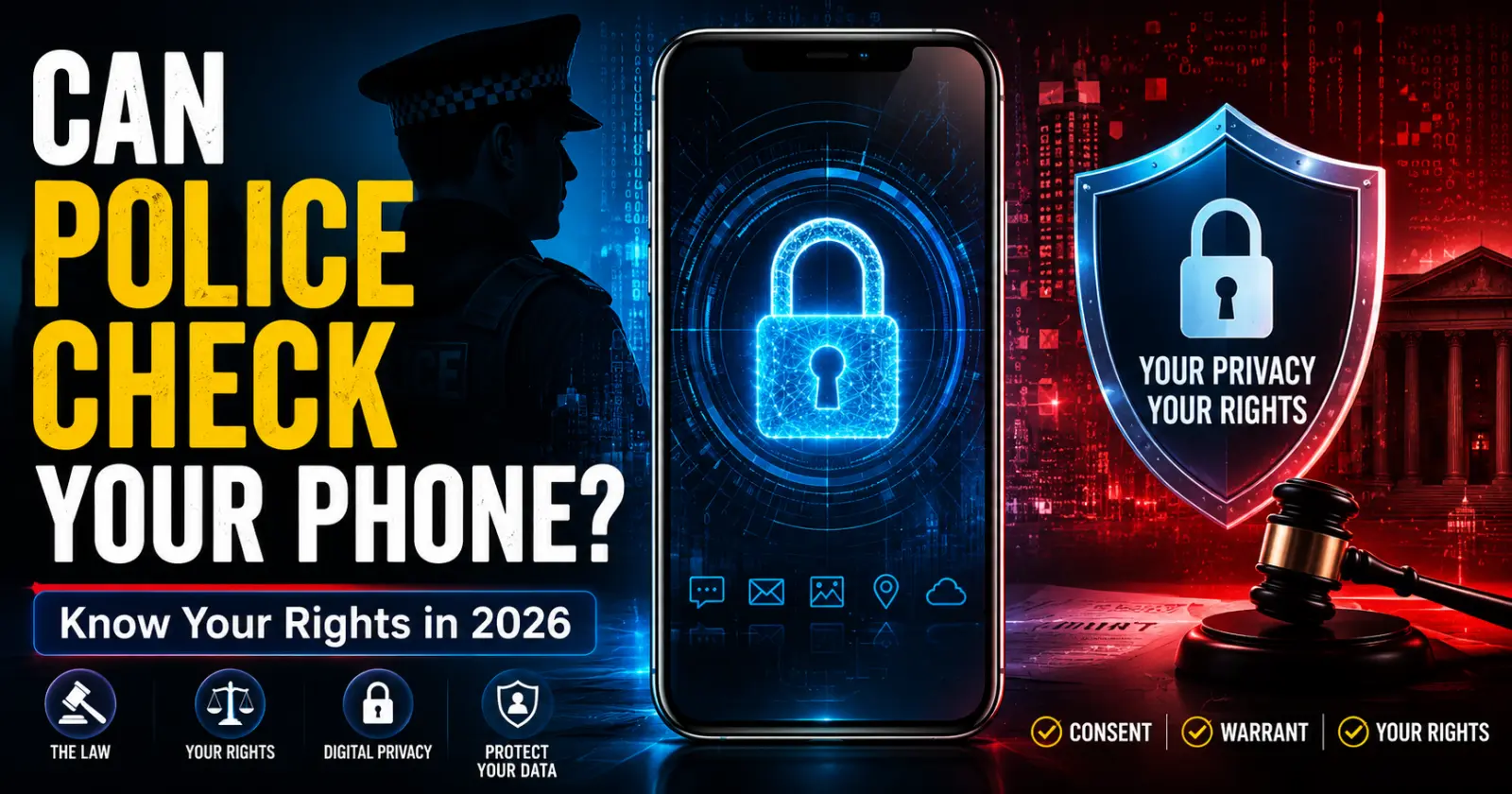
Can Police Check Your Phone Without Permission? Understanding Your Rights
In today's digital world, smartphones contain more personal information than almost any other item we carry. From private conversations and photographs to banking information, emails, social media accounts, location history, and work documents, a mobile phone often serves as a detailed record of a person's life.
Because of the vast amount of information stored on smartphones, many people wonder: Can police check your phone without your permission?
The answer is not always straightforward. It depends on the laws of the country, the circumstances of the investigation, whether a warrant exists, and whether consent has been given.
Understanding your rights can help you make informed decisions during interactions with law enforcement while ensuring you comply with applicable laws.
Disclaimer: This article is for general informational purposes only and should not be considered legal advice. Laws vary by country, state, and jurisdiction. Consult a qualified lawyer for advice regarding your specific situation.
Why Smartphones Receive Special Legal Protection
Historically, law enforcement could search physical items found on a person during an arrest, such as wallets, bags, or papers, under certain circumstances.
Smartphones changed the legal landscape.
Unlike traditional objects, a smartphone may contain:
Years of private communications
Personal photographs and videos
Medical information
Financial records
Location history
Internet browsing activity
Business documents
Social media accounts
Cloud-based data
Because smartphones contain extensive personal information, courts in many countries have recognized that digital privacy deserves stronger protections than ordinary physical possessions.
The General Rule: Police Usually Need Legal Authority
In many democratic legal systems, law enforcement generally cannot search the contents of your phone without proper legal authority.
This authority may come through:
Your consent
A search warrant
Specific emergency circumstances
Certain arrest-related exceptions recognized by local law
The exact requirements depend on where you live and the facts of the situation.
Scenario 1: You Voluntarily Give Permission
The simplest way police can access a phone is through consent.
If an officer asks:
"Can I take a look at your phone?"
and you voluntarily agree, the search may become legally permissible in many jurisdictions.
Why Consent Matters
When a person freely grants access:
Police may not need a warrant.
Information discovered may potentially be used in an investigation.
It may become more difficult later to challenge the search.
Important Considerations
Many legal experts advise understanding exactly what you are consenting to before granting access.
Questions may include:
Which applications can be examined?
How long will access be granted?
Will data be copied?
Will the phone be retained?
Consent should generally be voluntary rather than the result of threats or coercion.
Scenario 2: Police Have a Search Warrant
One of the most common ways law enforcement obtains access to a phone is through a judicial warrant.
A warrant is typically issued by a judge or magistrate after reviewing evidence suggesting that relevant information may be located on the device.
What a Warrant Usually Includes
A warrant often specifies:
The device to be searched
The suspected offense
The scope of the search
Any limitations imposed by the court
The existence of a warrant can significantly change the legal analysis.
Can You Refuse?
Even when a valid warrant exists, legal obligations regarding device access may differ depending on local laws.
Questions concerning passcodes, biometric unlocking, and encryption often involve complex legal issues that vary between jurisdictions.
Scenario 3: During an Arrest
Many people assume that an arrest automatically gives police unlimited access to a smartphone.
In reality, the issue is more complicated.
In several countries, courts have distinguished between:
Physically seizing a phone
Searching the contents of a phone
Police may sometimes take possession of a device to preserve evidence while seeking additional legal authorization to examine its contents.
Whether they can immediately search the device depends on local law and applicable court decisions.
Scenario 4: Emergency Situations
Certain emergency situations may create exceptions to ordinary warrant requirements.
Examples may include:
Imminent threats to life
Kidnapping investigations
Missing persons cases
Terrorism-related emergencies
Situations involving immediate public danger
Courts often evaluate whether officers reasonably believed urgent action was necessary.
Emergency exceptions are generally interpreted narrowly and are not intended for routine investigations.
What About Face ID and Fingerprint Unlocking?
One of the most debated legal questions involves biometric authentication.
Modern smartphones often use:
Fingerprint recognition
Facial recognition
Iris scanning
The legal treatment of biometric unlocking differs significantly around the world.
Common Legal Questions
Courts have considered questions such as:
Can police require a fingerprint unlock?
Can police require facial recognition unlock?
Is a passcode treated differently from biometric data?
Does compelling access violate constitutional or privacy rights?
Different countries—and sometimes different courts within the same country—have reached different conclusions.
Because laws continue to evolve, individuals should seek local legal advice regarding their specific jurisdiction.
Can Police Read Deleted Messages?
Many people believe deleted information disappears permanently.
In reality, deleted data may sometimes be recovered through:
Device forensics
Cloud backups
Third-party services
Service provider records
Whether law enforcement can access such information depends on legal authority, technical capabilities, and applicable privacy laws.
Deletion does not necessarily guarantee information can never be recovered.
Can Police Access Cloud Data?
Modern smartphones often store information beyond the device itself.
Examples include:
Cloud photo libraries
Email services
Document storage
Backup systems
Messaging platforms
Even if information is not physically stored on the phone, investigators may seek access through lawful legal processes directed at service providers.
Cloud-stored information frequently involves separate legal considerations from device searches.
What Rights Do Individuals Generally Have?
Although laws vary, many legal systems recognize certain fundamental principles.
Right to Know Why You're Being Detained
In many jurisdictions, individuals have the right to understand the reason for a stop, detention, or arrest.
Right to Remain Silent
Some legal systems recognize a right to avoid self-incrimination.
The scope of this right varies depending on local law.
Right to Legal Representation
Individuals often have the right to consult with a lawyer during criminal investigations.
Right to Challenge Unlawful Searches
If a search is conducted improperly, legal remedies may exist through courts or administrative procedures.
Common Mistakes People Make
1. Assuming They Must Automatically Consent
Many people mistakenly believe they are required to consent whenever asked.
Legal obligations depend on the circumstances and applicable law.
2. Arguing With Officers
Disputes should generally be handled through legal channels rather than physical resistance or confrontation.
3. Deleting Information During an Investigation
Attempting to destroy evidence may create additional legal problems in some situations.
4. Providing False Information
Giving false statements to law enforcement can lead to serious consequences.
5. Relying on Social Media Advice
Legal rights differ significantly between countries and states.
Advice that applies in one jurisdiction may be completely incorrect elsewhere.
How Smartphone Privacy Laws Are Evolving
As technology advances, lawmakers and courts continue adapting privacy protections.
Several emerging issues include:
Artificial Intelligence and Investigations
AI-powered forensic tools can process large amounts of digital evidence more efficiently than ever before.
Encrypted Messaging Platforms
Applications offering end-to-end encryption continue to raise questions about privacy and lawful access.
Digital Privacy Rights
Many governments are debating stronger privacy protections for personal data.
Cross-Border Data Requests
As cloud services operate globally, international cooperation between governments increasingly affects digital investigations.
The legal landscape continues to evolve alongside technology.
Practical Tips for Protecting Your Privacy
While respecting the law, individuals can take reasonable steps to secure personal information.
Use Strong Passwords
Long, unique passwords provide stronger protection than simple combinations.
Enable Device Encryption
Most modern smartphones include encryption features that help protect stored information.
Keep Software Updated
Security updates often fix vulnerabilities that could expose personal data.
Review App Permissions
Many applications collect more information than users realize.
Understand Local Laws
Knowing your rights and obligations can help avoid confusion during encounters with law enforcement.
Frequently Asked Questions About Police Phone Searches
Many misconceptions exist regarding digital privacy and police authority. Understanding the basics can help individuals make informed decisions when interacting with law enforcement.
Conclusion
Smartphones contain some of the most personal information people possess, making digital privacy an increasingly important legal issue.
In many jurisdictions, police cannot simply search a phone whenever they wish. Access often depends on factors such as consent, warrants, emergencies, arrests, and local laws.
However, the exact rules vary significantly across countries and legal systems. What is lawful in one jurisdiction may not be lawful in another.
As technology continues to evolve, courts and lawmakers will likely continue refining the balance between public safety and personal privacy.
The most important takeaway is simple: understand your rights, understand your responsibilities, and seek qualified legal advice whenever a specific legal issue arises.
Relevant Bare Act Provisions (India)
1. Section 94 BNSS, 2023 – Summons to Produce Documents or Electronic Devices
Section 94 allows a Court or a police officer in charge of a police station to require the production of documents, electronic communications, and communication devices that may contain digital evidence relevant to an investigation. This means police may legally require production of a phone or digital device under a written order in appropriate circumstances.
What It Means for Your Phone
- Police cannot simply browse through your phone because they are curious.
- However, if the device is believed to contain evidence relevant to an investigation, they may seek its production through legal procedures.
- Mobile phones are specifically recognized as communication devices capable of containing digital evidence.
2. Section 49 BNSS, 2023 – Search of Arrested Person
Section 49 authorizes police to search an arrested person and take articles found on that person into custody, subject to the provisions of the law. A receipt must be provided for seized articles.
What It Means for Your Phone
- If you are lawfully arrested, police may seize a mobile phone found on you.
- Seizure of the phone does not automatically mean unrestricted access to all its contents.
- Further examination of digital data may involve additional legal processes depending on the circumstances.
3. Section 185 BNSS, 2023 – Search by Police Officer
Section 185 empowers an investigating officer to conduct a search when there are reasonable grounds to believe that evidence relevant to an investigation may be found and obtaining it otherwise would cause undue delay. The officer must record reasons in writing.
What It Means for Your Phone
- Police cannot conduct arbitrary searches.
- The investigating officer must record reasons.
- The search must be linked to a lawful investigation.
- Safeguards and documentation requirements apply.
4. Section 105 BNSS, 2023 – Audio-Video Recording of Search and Seizure
BNSS introduced an important safeguard requiring searches and seizures under the relevant chapter, including searches under Section 185, to be recorded through audio-video electronic means, preferably using a mobile phone.
Why This Matters
- Increases transparency.
- Reduces chances of procedural abuse.
- Creates a record that may later be reviewed by courts.
5. Article 21 of the Constitution and the Right to Privacy
Although not a "Bare Act section," the landmark judgment in the Justice K.S. Puttaswamy v. Union of India case recognized privacy as a fundamental right under Article 21 of the Constitution of India.
Why This Matters
Your smartphone contains:
- Personal photographs
- Financial information
- Messages
- Health records
- Location history
Because of this, courts generally treat digital privacy seriously, and any intrusion into personal data must satisfy legal requirements and constitutional safeguards.
Quick Answer: Can Police Check Your Phone Without Permission?
Generally, No
A police officer ordinarily cannot stop you on the road and randomly scroll through your phone merely out of curiosity.
They May Access or Seize a Phone When
- You voluntarily consent.
- The phone is relevant to an investigation.
- A lawful search or seizure is conducted under BNSS provisions.
- A court warrant or lawful order exists.
- Emergency circumstances recognized by law apply.
They Cannot Simply Say
"Give me your phone so I can check your WhatsApp and photos."
without a lawful basis, investigation-related justification, or valid legal authority.
FREQUENTLY ASKED QUESTIONS
1. Can police check my phone without my permission?
In many jurisdictions, police generally need your consent, a warrant, or another legal basis to search the contents of your phone.
2. Can police force me to unlock my phone?
The answer varies by country and legal system. Laws regarding passcodes, fingerprints, and facial recognition differ significantly.
3. Can police take my phone during an arrest?
In some situations, police may seize a phone as potential evidence, though searching its contents may require additional legal authority.
4. Can deleted messages be recovered?
Sometimes. Deleted data may still exist in backups, cloud services, or device storage and may be recoverable through forensic methods.
5. Do police need a warrant to read text messages?
Often they do, but requirements vary depending on jurisdiction and circumstances.
6. Can police access WhatsApp messages?
Access depends on applicable laws, warrants, device access, cloud backups, and the platform's technical architecture.
7. Is Face ID legally different from a passcode?
Many courts have treated biometric authentication differently from memorized passwords, though rules vary.
8. Can police access photos stored in the cloud?
In some cases, authorities may seek cloud data through lawful legal processes directed at service providers.
9. What should I do if police ask to search my phone?
Remain calm, be respectful, and consider seeking legal advice if you are unsure about your rights and obligations.
10. Are smartphone privacy laws changing?
Yes. Courts and lawmakers worldwide continue updating digital privacy laws as technology evolves.
11. Which sections of BNSS are most relevant to phone searches?
The most commonly cited provisions are:
- Section 49 – Search of Arrested Person
- Section 94 – Production of Documents and Communication Devices
- Section 105 – Audio-Video Recording of Search and Seizure
- Section 185 – Search by Police Officer
These provisions collectively govern how electronic devices may be searched, produced, or seized during criminal investigations.
This legal framing will make the article significantly more authoritative and useful for Indian readers while staying closer to the actual BNSS provisions.
Written by Ashish
Career Guidance Mentor & Government Job CounsellorAshish regularly writes about government jobs, educational opportunities, competitive examinations, career planning, and student development.
Read Full Author Profile
Recent Posts


UPSC Advertisement No. 06/2026

What Happens If You Don't Pay a Traffic Challan
Can Police Check Your Phone Without Permission

ChatGPT vs Gemini vs Claude: Which AI Is Best in 2026

IPC vs BNS Top 50 Important Changes Every Student Must Know (2026 Guide)

What Happens If You Don't Pay a Traffic Challan in India Complete Guide (2026)

RRB ALP 2026 Notification 11,127 Assistant Loco Pilot Vacancies Announced, Eligibility, Exam Pattern & Important Dates
